Building apps today often feels like aiming at a moving target. Features that felt advanced a year ago now feel expected, while user behavior keeps shifting faster than most development cycles can keep up with. That tension is exactly why events like Mobile World Congress matter. They do not just showcase devices. They quietly reveal how people will interact with technology next.
The real value for developers is not in the hardware itself, but in the patterns behind it. MWC 2026 made one thing clear: user expectations are evolving toward intelligence, fluidity, and context-aware experiences. That shift carries direct implications for mobile app development.
Interfaces Are Becoming Context-Aware, Not Static
One of the most noticeable changes across showcased innovations is how interfaces adapt in real time. Screens are no longer fixed experiences. They respond to environment, usage, and intent.
For developers, this signals a move away from rigid UI structures.
Instead of designing for predefined screens, mobile app development must now consider:
- Context-driven layouts that adapt to user behavior
- Interfaces that shift based on time, location, or activity
- Reduced reliance on manual navigation
Apps that feel responsive to context create a sense of intelligence, even without complex features. This is where user experience begins to feel intuitive rather than guided.
AI Is Quietly Becoming the Core Layer
The presence of AI at MWC 2026 was not loud or experimental. It was integrated.
Features powered by AI no longer feel like add-ons. They operate in the background, enhancing speed, personalization, and decision-making without requiring user input.
This changes how mobile app development should approach functionality.
Instead of building features first and layering intelligence later, the approach shifts toward:
- Designing features that learn from usage patterns
- Automating small decisions to reduce friction
- Creating predictive experiences rather than reactive ones
At the same time, the broader ecosystem reflects how AI-first web development is changing site building in 2026, and mobile applications are following a similar trajectory, where intelligence is embedded from the ground up.
Performance Expectations Are No Longer Forgiving
Devices showcased this year highlight a clear trend: speed is assumed, not appreciated.
Users are interacting with faster processors, better connectivity, and more efficient systems. That raises the baseline expectation for app performance.
For mobile app development, this means:
- Lag is no longer tolerated, even in feature-heavy apps
- Load times must feel instant, not optimized
- Background processes must remain invisible
Optimization is no longer a technical advantage. It is a basic requirement.
Developers who ignore this shift risk building apps that feel outdated, regardless of how advanced the features are.
Cross-Device Continuity Is Becoming Standard
Another key takeaway is how seamlessly users move between devices. The experience does not reset. It continues.
Whether switching screens, devices, or input methods, the interaction remains consistent. This has a direct impact on mobile app development strategies.
Instead of treating mobile apps as isolated platforms, developers need to think in terms of ecosystems:
- Sessions that continue across devices without interruption
- Data synchronization that feels immediate and invisible
- Interfaces that adapt without losing familiarity
The focus shifts from building an app to building an experience that travels with the user.
Hardware Innovation Is Changing Interaction Design
Advancements in form factors are quietly redefining how users engage with apps.
Flexible displays, new input methods, and enhanced sensors are expanding the ways users interact beyond simple taps and swipes.
For mobile app development, this introduces new considerations:
- Designing for dynamic screen sizes and orientations
- Supporting gesture-based and voice-driven interactions
- Creating layouts that adjust without breaking usability
Developers who design only for traditional interaction models may miss how quickly user behavior is evolving.
Simplicity Is Becoming a Competitive Advantage
Despite the complexity of new technologies, the most impactful experiences showcased were surprisingly simple.
The emphasis is shifting toward reducing cognitive load. Users prefer apps that feel effortless, not feature-heavy.
This creates an important shift in mobile app development priorities:
- Fewer steps to complete actions
- Clear, distraction-free interfaces
- Features that solve specific problems instead of trying to do everything
Simplicity is no longer minimalism for aesthetics. It is efficiency for attention.
Privacy and Control Are Becoming Visible Features
Another subtle but important trend is how privacy is being surfaced within the user experience.
Instead of hiding permissions and controls, systems are making them more transparent and accessible.
According to leading mobile app developers, this changes how trust is built.
Mobile app development now requires:
- Clear communication of data usage
- User-friendly privacy controls
- Features that give users a sense of control without confusion
Trust is no longer assumed. It is designed into the experience.
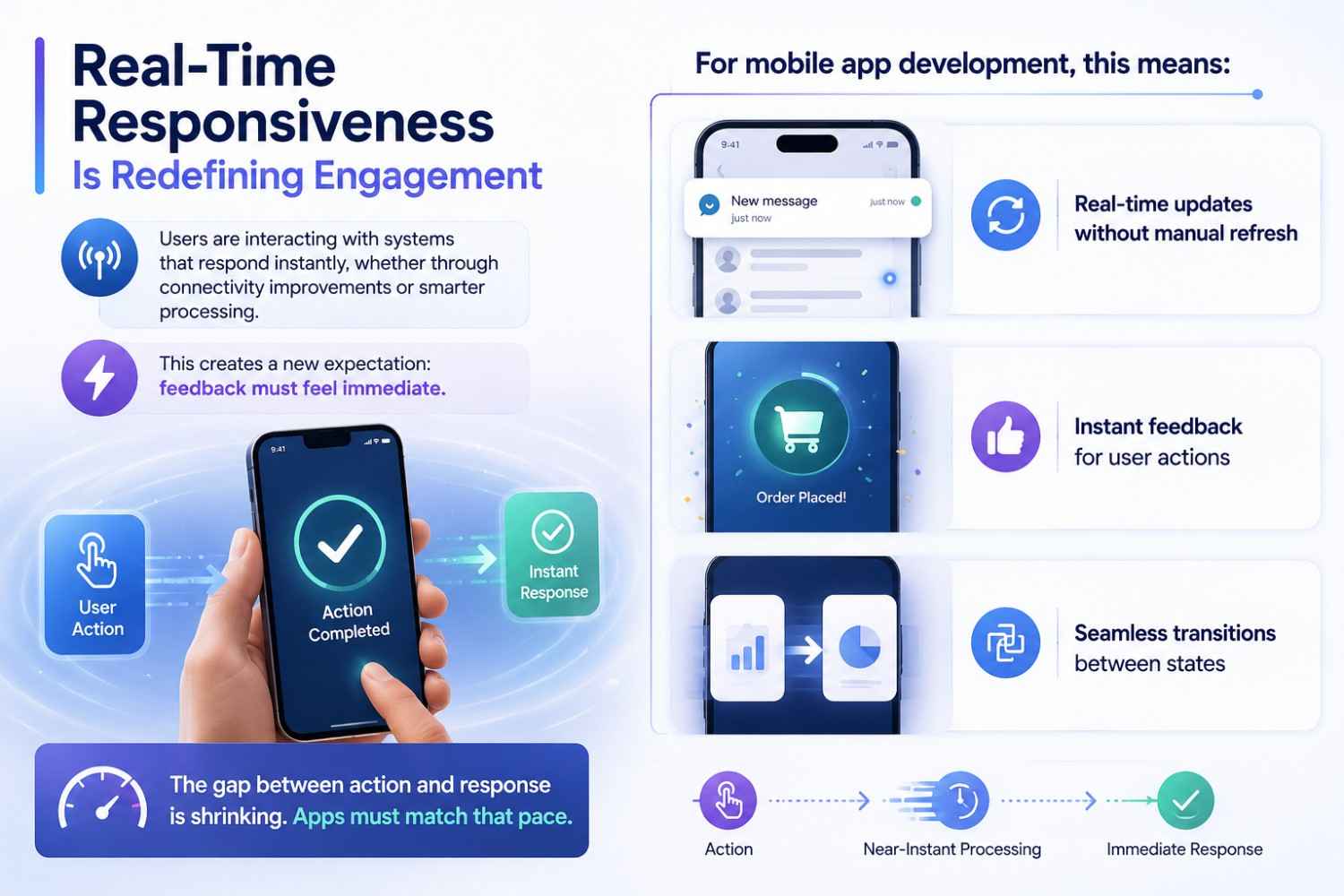
Real-Time Responsiveness Is Redefining Engagement
Users are interacting with systems that respond instantly, whether through connectivity improvements or smarter processing.
This creates a new expectation: feedback must feel immediate.
For mobile app development, this means:
- Real-time updates without manual refresh
- Instant feedback for user actions
- Seamless transitions between states
The gap between action and response is shrinking. Apps must match that pace.
Developers Are No Longer Just Builders
MWC 2026 highlights a deeper shift in the role of developers.
The focus is no longer limited to building functional apps. It extends to shaping how users feel while interacting with those apps.
This changes the mindset behind mobile app development:
- From feature-driven thinking to experience-driven design
- From solving tasks to anticipating needs
- From building interfaces to creating interactions
The difference may seem subtle, but it defines how modern apps stand out.
Where the Next Wave of Apps Will Stand Out
The most important lesson from MWC 2026 is not about specific innovations. It is about direction.
Technology is moving toward experiences that feel:
- Faster without effort
- Smarter without complexity
- Connected without interruption
Developers who align with these principles will naturally build applications that feel relevant.
The shift is not about chasing trends. It is about understanding behavior.
Because at the end of the day, users do not care about the technology behind an app. They care about how it fits into their lives.
And the apps that succeed will be the ones that feel like they belong there.