Quick Summary:
The debate around an AI bubble in 2026 centers on whether rapid investment and hype are outpacing real-world value. Skeptics argue that inflated expectations, unclear ROI, and overfunded projects signal potential risk. However, others point to genuine technological progress and long-term adoption as signs of sustainable growth. The reality likely sits in between, where short-term overvaluation coexists with long-term transformation.
A growing number of businesses are investing heavily in AI, yet many teams quietly ask the same question during strategy meetings: Are these investments delivering measurable outcomes, or just following market momentum?
This uncertainty has fueled a broader conversation about whether the AI industry is entering a speculative phase. While enthusiasm continues to rise, skepticism is becoming harder to ignore, especially among developers, technical leaders, and digital service providers who work closely with implementation realities.
The Gap Between Hype and Execution
AI has moved beyond experimental phases and into mainstream adoption. Yet, a noticeable gap exists between what AI promises and what it consistently delivers in production environments.
Skeptics highlight several concerns:
- Overestimation of short-term capabilities
- Underestimation of integration complexity
- Limited clarity on measurable business outcomes
Many organizations adopt AI tools expecting immediate transformation, only to face challenges in scaling those solutions effectively. This disconnect often creates the impression of inflated expectations, a classic indicator of a potential bubble.
Investment Surge Without Clear Benchmarks
Funding in AI-related initiatives has grown rapidly, but not all investments are grounded in clear performance metrics. This is one of the strongest arguments from market skeptics.
Unlike traditional software investments, where ROI can be tracked through efficiency or revenue gains, AI outcomes are often harder to quantify. This leads to:
- Projects driven by trends rather than defined goals
- Difficulty in distinguishing meaningful innovation from superficial implementation
- Increased risk of resource misallocation
For web development and AI service providers, this trend creates both opportunity and pressure. Clients demand AI-driven solutions, but expectations may not always align with practical feasibility.
Infrastructure Costs and Sustainability Concerns
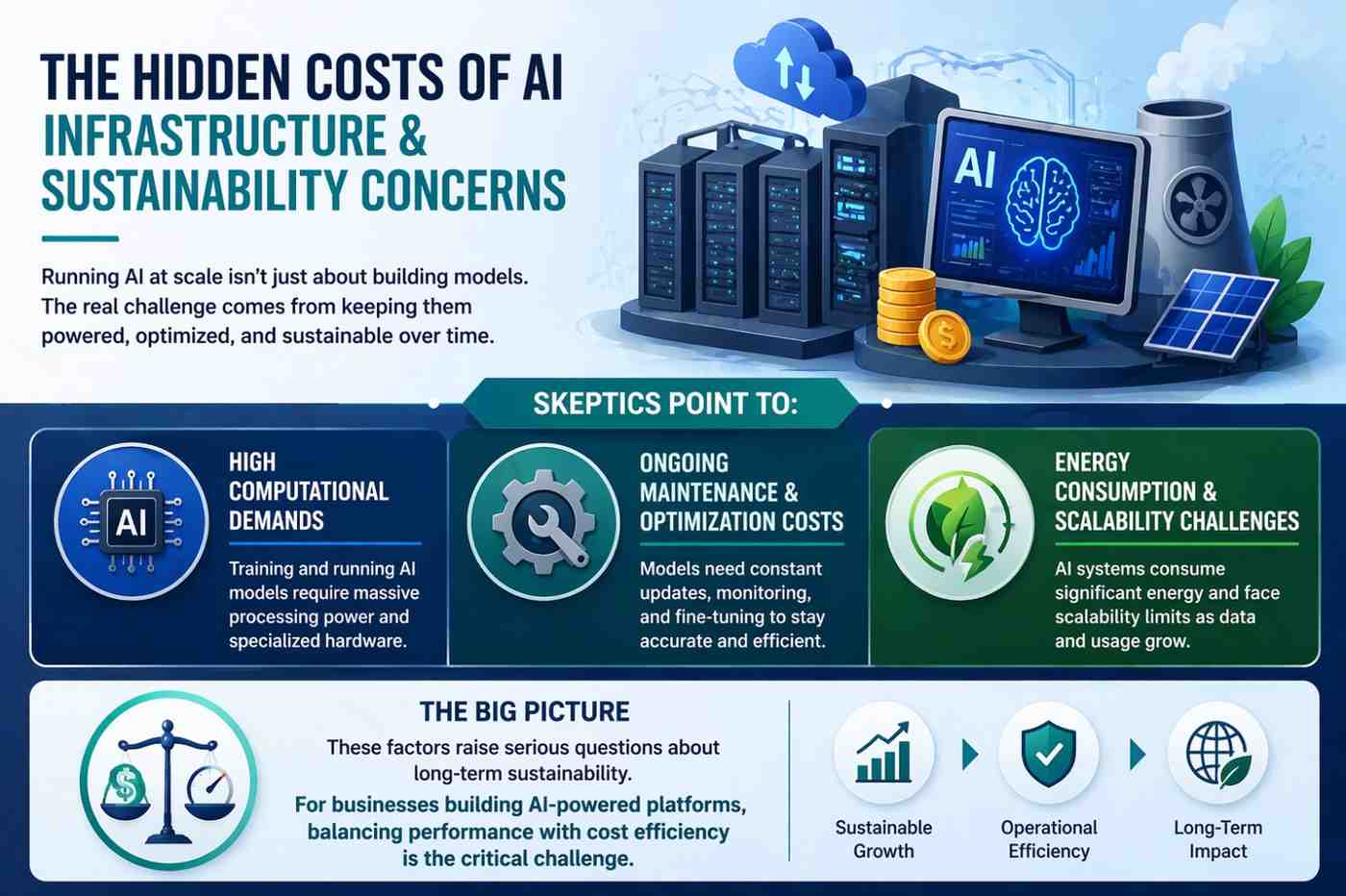
Another overlooked aspect in mainstream discussions is the cost of maintaining AI systems at scale. While initial prototypes may appear efficient, production-level deployment often requires significant infrastructure.
Skeptics point to:
- High computational demands
- Ongoing maintenance and optimization costs
- Energy consumption and scalability challenges
These factors raise questions about long-term sustainability. For businesses building AI-powered platforms, balancing performance with cost efficiency becomes a critical challenge.
The Illusion of Universal Applicability
AI is often presented as a solution that fits nearly every business problem. However, practical implementation reveals a more nuanced reality.
Not every process benefits from automation or predictive modeling. In some cases, traditional systems remain more efficient and reliable.
Skeptics argue that:
- AI is sometimes applied where simpler solutions would suffice
- Over-automation can reduce clarity rather than improve it
- Customization requirements limit scalability
This perspective is particularly relevant in web development, where user experience and performance often outweigh the need for complex AI integrations.
Talent Shortage and Skill Misalignment
The rapid expansion of AI has created a demand for specialized skills that the current workforce struggles to meet. This imbalance contributes to skepticism about the industry’s pace of growth.
Challenges include:
- Limited availability of experienced AI engineers
- Misalignment between business expectations and technical expertise
- Increased reliance on partially trained teams
For service-based businesses, this skill gap can lead to inconsistent project outcomes, reinforcing doubts about whether the industry is scaling sustainably.
Real Progress Beneath the Noise
Despite skepticism, dismissing AI as purely speculative would ignore significant advancements. Many applications are delivering tangible value, particularly in areas like automation, data analysis, and personalization.
What differentiates successful implementations?
- Clear problem definition before applying AI
- Integration with existing systems rather than isolated deployment
- Continuous optimization based on real-world feedback
These factors suggest that while hype exists, it does not invalidate the technology’s long-term potential.
A Shift Toward Practical AI Adoption
One of the most notable trends in 2026 is a gradual shift from experimental AI projects to practical, outcome-driven implementations.
Businesses are becoming more selective, focusing on:
- Use cases with measurable impact
- Scalable solutions that integrate seamlessly
- Long-term value rather than short-term novelty
This shift indicates a maturing market rather than an imminent collapse. It reflects a move toward sustainable growth, even if certain segments experience correction.
What This Means for Web Development and AI Services
For professionals working in web development and AI services, the “AI bubble” conversation is not just theoretical; it directly influences client expectations and project direction.
Key implications include:
- Greater emphasis on transparency in AI capabilities
- Need for realistic timelines and deliverables
- Focus on hybrid solutions combining AI with traditional systems
Rather than chasing trends, successful teams prioritize clarity, usability, and performance. This approach helps bridge the gap between innovation and practical value.
Reading the Market With a Balanced Lens
The idea of an AI bubble often stems from extremes, either overconfidence or excessive caution. A more balanced perspective recognizes that both hype and genuine progress can coexist.
Short-term volatility is not unusual in emerging technologies. What matters is how businesses navigate this phase.
Those who approach AI with strategic intent, focusing on real problems, measurable outcomes, and scalable solutions, are more likely to benefit regardless of market fluctuations.
Moving Forward With Informed Confidence
The conversation around an AI bubble is less about predicting a collapse and more about encouraging smarter adoption. Skepticism, when grounded in practical concerns, can serve as a valuable counterbalance to unchecked enthusiasm.
For businesses and developers, the goal is not to avoid AI but to engage with it thoughtfully. By prioritizing clarity over hype and execution over experimentation, it becomes possible to turn uncertainty into opportunity, and build solutions that stand the test of both market cycles and real-world demands.